LIDT Challenge 2026
The HiLASE Centre invites you to participate in the annual LIDT Challenge. This year, we will test a sample of your mirror with nanosecond pulsed lasers. In return, you will gain knowledge of your component's respective damage threshold.
The LIDT Challenge 2026 will place a special focus on optical components relevant to fusion and high-energy laser applications. With fusion-grade laser systems expected to operate at extreme fluence levels, high repetition rates, and long-term exposure, robust optics are a critical enabler of system reliability and safety. To keep the laser system compact and cost-effective, the optics must remain relatively small - however, this presents a challenge when meeting high fluence requirements. The 2026 testing campaign will therefore emphasize conditions and evaluation criteria aligned with the requirements of laser-driven fusion and related large-scale research infrastructures.
Why should you take part?
The reliability of high-power laser systems is fundamentally determined by the quality and robustness of their optical components. Even optics that perform well under low fluence or limited pulse counts may fail when exposed to high energy, high repetition rate conditions over longer periods.
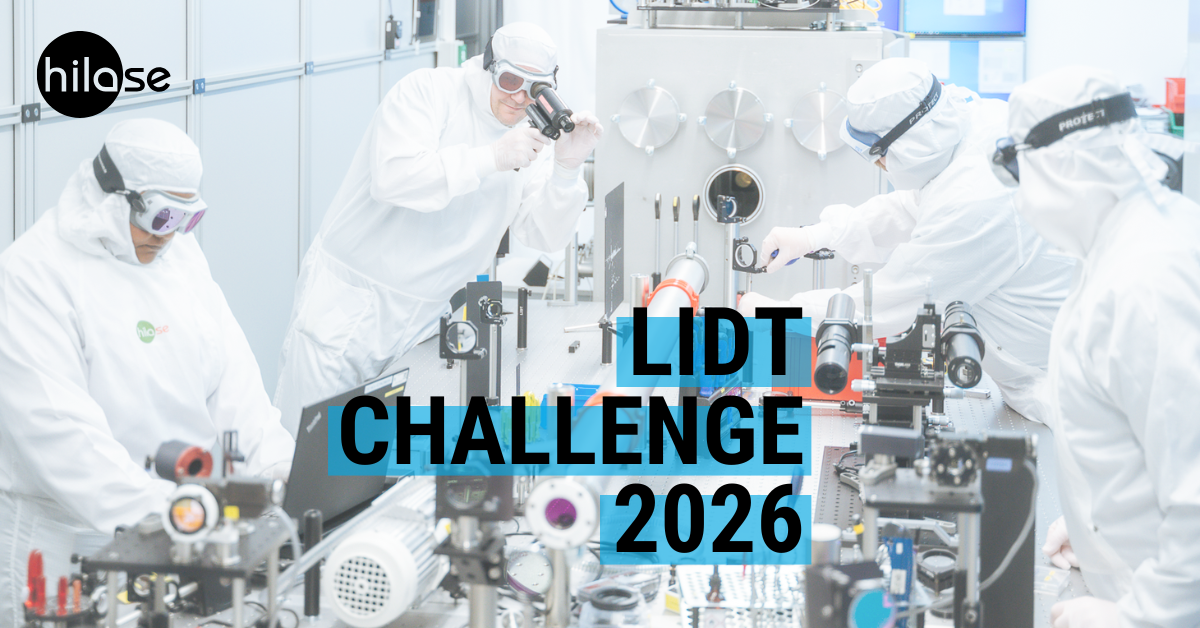
The LIDT Challenge, conducted at the HiLASE Centre, offers participants an independent, standardized, and realistic evaluation of their optical components under conditions that reflect the real-world operation of advanced laser systems.
Registration
To participate in the LIDT Challenge 2026, all interested parties must complete the registration process prior to sample submission.
Participants are required to:
- Complete the Contestant Registration Form
- Confirm their intention to submit samples for testing
- Agree to the conditions of participation, including anonymous evaluation and publication of results
Registration form HERE.
Samples
Each participant is required to submit three (3) identical samples in total:
- 1 test sample
- 2 witness samples
To ensure consistency, all samples should be sourced from the same batch and match precisely in substrate material, coating design, deposition process, and post-processing.
The witness samples may be used for verification, repeat measurements, or additional analysis if required.
Sample specifications
- Required sample diameter: 2″ or 50 mm
- Sample thickness: between 6.35-9.52 mm
- Angle of incidence: 40-50°
- All samples must have a clearly marked front surface (S1) with an ^ mark, the tip directing to S1 surface
Optical requirements
- Highly reflective coated laser sample
- Reflectance: > 99.5% for p-polarization
- Central wavelength: 1030 ±2 nm
- Clear aperture: >90%
- Provide measured spectral characteristics of the sample (R%, Rp% preferred)
In case of any questions regarding the samples, please contact Mihai-George Mureșan at mihai@fzu.cz (+420 314 007 742).
Packaging and shipment
Samples must be delivered to the HiLASE Centre no later than 01 June 2026 to the following address:
HiLASE Centre – LIDT Challenge
Institute of Physics of the Czech Academy of Sciences
Mihai-George Mureșan
Za Radnicí 828
252 41 Dolní Břežany
Czech Republic
Please ensure that all samples are:
- Properly packaged to prevent mechanical or surface damage during transport
- Clearly labeled for internal identification only
- Accompanied by two identical witness samples
- Each shipment must be clearly marked with the note: “LIDT Challenge”
Testing conditions
Anonymized samples will be tested using a modified s-on-1 method in accordance with ISO 21254-2:2011, up to 30000 pulses per sample. Each sample will be tested in five stages, starting at 5 J/cm² and increasing in increments of 2.5 J/cm² up to 15 J/cm². Each stage will be performed on a pristine area of the sample surface. Every testing stage will last for a maximum of 6 000 pulses, or until damage is detected.
- Pulse duration: 10 ns
- Repetition rate: 10 Hz
- Beam profile: square, flat top
- Polarization: linear, p
- Test spot diameter: ~5x5 mm
- Maximum fluence: 15 J·cm⁻²
We will use our high-energy, high repetition rate laser system Bivoj to test the submitted samples.
Environmental conditions
- Vacuum
- Room temperature: 22–24 °C
What will happen next?
After sample submission and testing, participants will gain a unique insight into the real performance of their optical components under demanding conditions representative of high-end laser systems.
All samples will be evaluated at the HiLASE under controlled and reproducible conditions. The results will be processed and assessed in anonymized form.
The aggregated and anonymized results of the LIDT Challenge 2026 will be presented publicly online in October 2026.
Looking ahead: the LIDT Challenge 2027 will target 343 nm HR optics, pushing laser-damage testing further into the deep-UV regime.
Why use HiLASE testing?
We often see optical elements fail when used in high energy, high repetition rate systems, even though they work well when exposed to small diameter beams or low pulse counts. Therefore, we aim to maximize the laser beam diameter during measurements combined with long-term exposure to laser radiation, which, combined with the recommendations of ISO standards for LIDT, will ensure reliable results that reflect the robustness of the optics under real-world conditions. At the HiLASE Centre we provide state-of-the-art testing of materials and components for laser resistance under controlled conditions in our ISO 9001 certified LIDT laboratory.